Ask most owners what happens if someone breaks into their empty building and starts living there, and the assumption is usually that it's a police matter. Whether that's actually true depends heavily on what kind of building it is, and it catches a lot of owners out.
Residential buildings: a specific criminal offence
Since 1 September 2012, squatting in a residential building has been a distinct criminal offence in England and Wales under section 144 of the Legal Aid, Sentencing and Punishment of Offenders Act 2012. Broadly, someone commits the offence if they enter a residential building as a trespasser, know or reasonably ought to know they're trespassing, and are living there, or intend to. A conviction can carry a custodial sentence, a fine, or both.
In principle this gives the police a direct route to act. In practice, officers attending the scene still need to establish, often with limited information, that the building genuinely counts as residential, that entry really was trespass, and that the occupants are actually living there rather than passing through. That's not always straightforward at a building nobody has visited in months, and it's part of why enforcement in practice can be inconsistent.
Commercial and mixed-use buildings sit outside this offence
Section 144 only applies to buildings that were designed or adapted for living in before the trespasser entered. Former offices, shops, and other buildings not established as residential fall outside it entirely. Recovering those remains a civil matter: typically an application for an Interim Possession Order through the courts, rather than a straightforward call to the police.
That route works, but it takes time and money, and the building sits exposed for as long as the process runs. For commercial and mixed-use property in particular, that's a real and ongoing gap in protection compared with residential stock.
A different picture once a building is lawfully occupied
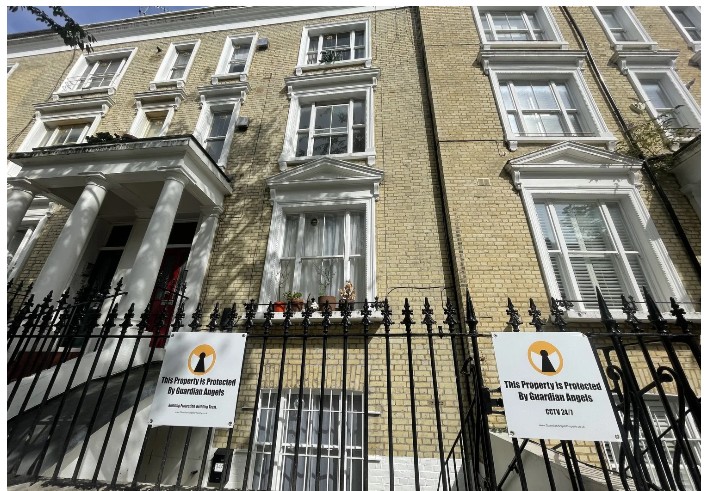
This is where a guardianship arrangement changes more than just how a building looks from the outside. Once vetted guardians are living in a property under a proper Property Licence Agreement, that occupation is lawful, and forcing entry against it is a criminal matter in its own right, engaging offences under the Criminal Law Act 1977 and, depending on circumstances, the Theft Act 1968. That means the police can respond directly to a forced-entry incident against an occupied guardian property, rather than the owner needing to start civil proceedings after something has already gone wrong.
Put simply: guardianship doesn't just make a building less appealing to opportunists, which it does. It also moves the building onto the criminal side of the legal line from day one, instead of needing to get there only after an incident occurs.
Why the distinction matters in practice
- An empty residential building depends on section 144 being correctly recognised and enforced at the point of an incident.
- An empty commercial or mixed-use building has no equivalent criminal protection, and recovery generally means a civil court process.
- A guardian-occupied building is protected from the point occupation begins, since unauthorised forced entry against a lawful occupant is itself a criminal offence.
For owners holding a building empty for an uncertain period, through planning, probate, or a slow sale, this legal distinction is often just as significant as the physical deterrence guardianship provides.
Managing a vacant or recently recovered property? We can advise on the right protection approach, and where needed, work alongside your solicitors on recovery and re-occupation.
This article provides general information on the law in England and Wales as at August 2026 and is not legal advice. Every situation is different; property owners should take independent legal advice on their specific circumstances.